
Photo: Koalisi Seni
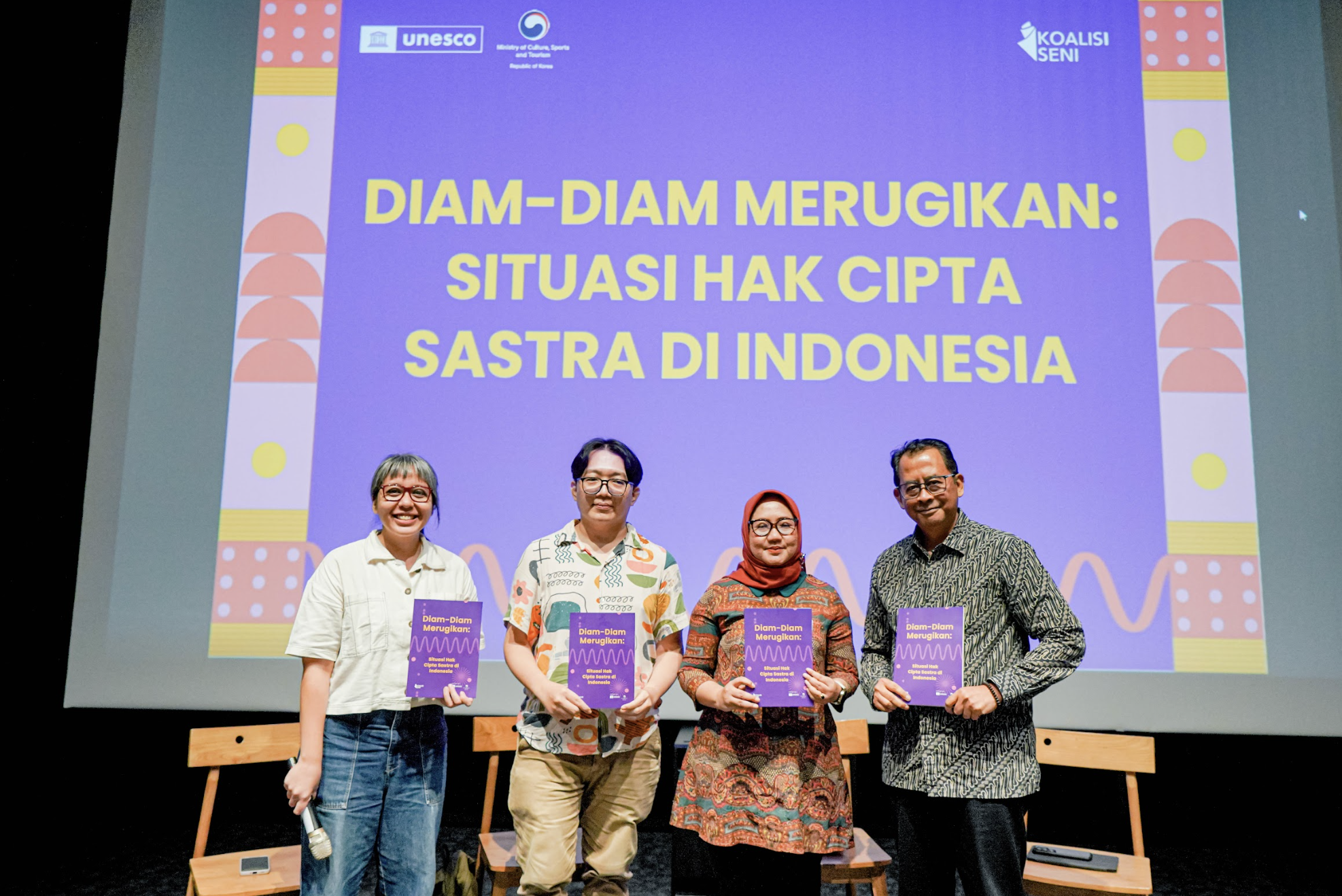
Jakarta, 29 April 2026 – Koalisi Seni launched its research series, A Quiet Damage: The State of Copyright in Indonesia’s Arts Sector, at Kineforum, Taman Ismail Marzuki, Jakarta. The launch marked the beginning of a series of public discussions across different artistic disciplines in response to the ongoing revision of Indonesia’s Copyright Law No. 28 of 2014.
Amid rapid digital transformation, artistic works can now be distributed more widely and more quickly than ever before. At the same time, however, copyright protection has not fully kept pace with these changes. This imbalance has had a direct impact on artists’ economic rights, particularly regarding royalty transparency, fairer contractual and licensing practices, and recognition of creative works in digital spaces.
With the support of UNESCO Jakarta and the Korea Funds-in-Trust, Koalisi Seni has expanded its previous research initiative on the music sector to include five additional artistic disciplines: literature, dance, film, visual arts, and theatre. The research aims to provide a comprehensive picture of copyright challenges across the arts while laying the groundwork for more equitable policymaking. UNESCO representative Moe Chiba described the research as “a pioneering study, especially in Southeast Asia,” emphasizing that “these sectors came together to work and address the problem,” highlighting a form of cross-sector collaboration that remains rare across the region.
Literature: Limited Copyright Awareness and Unequal Power Relations
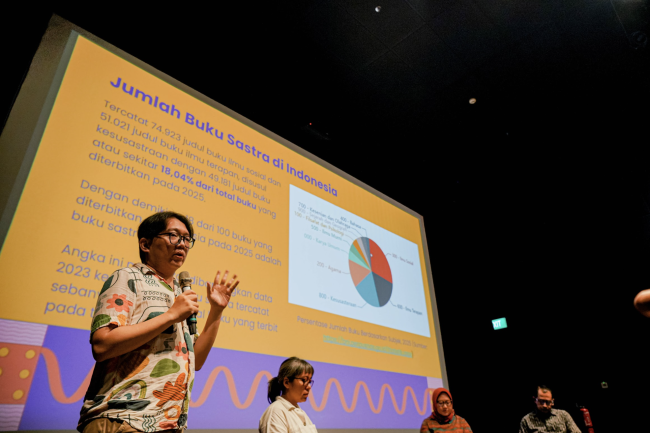 Photo: Koalisi Seni
The literature discussion featured Martin Suryajaya (Literary Copyright Researcher), Nisa Rengganis (Author), and Dr. Agung Damarsasongko (Director of Copyright and Industrial Design, Ministry of Law of the Republic of Indonesia), moderated by Ratri Ninditya (Research Coordinator, Koalisi Seni). The discussion emphasized that copyright issues in the literary sector extend beyond piracy to include limited awareness among authors of their own rights, as well as unequal power relations within the publishing ecosystem.
Martin Suryajaya stressed that these issues should be understood as part of a broader system. He explained, “copyright management should be seen as an ecosystem, and within that ecosystem there are unequal power relations among different actors—from writers and publishers to online marketplaces.” This perspective illustrates that writers’ vulnerability is not an isolated issue, but rather one shaped by the broader industry structure through which literary works are created, distributed, and monetized.
At the level of creators, limited understanding of copyright remains one of the sector’s greatest challenges. Nisa Rengganis pointed out that many writers are still unaware of the rights attached to their own works. She noted, “the main issue is that many writers are not even aware of their own copyright. Emerging writers often feel that having their work published is enough, without understanding the contracts they sign or the economic rights associated with them.”
The discussion also highlighted practices that disadvantage authors, including unauthorized republication, opaque “buyout” arrangements, and widespread piracy in both physical and digital forms. While digital platforms have significantly expanded opportunities for distributing literary works, they have also created new avenues for copyright infringement, including unauthorized reproduction and the modification of works without proper attribution.
From the government’s perspective, copyright protection has become increasingly complex as infringement has shifted into digital spaces. Dr. Agung Damarsasongko remarked, “people no longer sell pirated books in Senen; now they sell them through e-commerce platforms and social media.” He also emphasized that the Directorate General of Intellectual Property remains open to receiving policy recommendations from artists and literary practitioners, particularly on strengthening copyright protection and developing more effective collective advocacy mechanisms.
Overall, the discussion demonstrated that strengthening copyright protection in the literary sector requires more than legal enforcement. It also calls for greater copyright literacy among authors, increased transparency in publishing practices, and a more equitable ecosystem for everyone involved in literary production.
Dance: Unauthorized Distribution and the Loss of Artists’ Rights
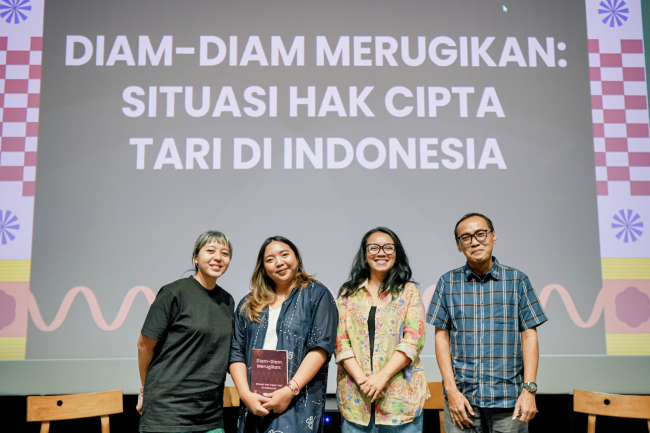
Photo: Koalisi Seni
The dance discussion featured Kennya Rinonce (Dance Copyright Researcher), Yola Yulfianti (Choreographer), and Noryanto, S.Ant. (Ministry of Culture), moderated by Ratri Ninditya (Research Coordinator, Koalisi Seni). The discussion highlighted persistent concerns surrounding the documentation and distribution of dance works without permission. In the performing arts, recordings and redistributions are frequently carried out without regard for either the economic or moral rights of artists. This reflects the significant challenges copyright protection continues to face in the performing arts, particularly in ensuring creators retain control over how their works are used and shared in digital spaces.
Kennya Rinonce pointed to the lack of documentation practices among dance practitioners as one of the sector’s most fundamental issues. She stated, “awareness of the importance of simply documenting one’s work remains very low among choreographers.” Yet documentation forms the foundation for establishing evidence of authorship, enabling creative works to receive copyright protection while also serving as the basis for managing economic rights in the future. The research further found that copyright issues frequently arise when choreography is incorporated into other artistic media, such as film. Ambiguities surrounding professional roles and contractual arrangements risk undermining choreographers’ moral rights as well as their ability to manage the economic rights attached to their creations.
Drawing from professional practice, Yola Yulfianti highlighted the complexity of choreographic work, which is often not matched by the recognition or legal protection it receives. She emphasized that the challenge extends beyond documentation to the way creative labour itself is valued within an industry ecosystem that has yet to provide equitable recognition for choreographers.
Meanwhile, Noryanto of the Ministry of Culture explained that copyright protection begins the moment a work is made public. He stated, “copyright is declarative. Once a work is uploaded, it is already protected.” Nevertheless, he stressed that the greater challenge lies in building awareness among artists about the importance of documenting their work and understanding the rights attached to it.
The discussion also underscored the unique nature of dance as an ephemeral art form—one that is constantly evolving through the bodies of its performers and therefore cannot easily be fixed in a permanent form. This characteristic further complicates the distinction between inspiration, adaptation, and imitation, particularly when choreographic works draw upon traditions or communal cultural practices.
More broadly, the speakers agreed that strengthening the dance ecosystem is essential. This includes developing comprehensive databases of dance works, improving copyright literacy, and encouraging the establishment of collective mechanisms capable of safeguarding artists’ interests. Such efforts are vital to ensuring that dance is not only legally protected, but also continues to thrive, remain relevant, and be accessible to the public without compromising the rights of its creators.
Film: Unclear Contracts and the Challenges of Digital Platforms
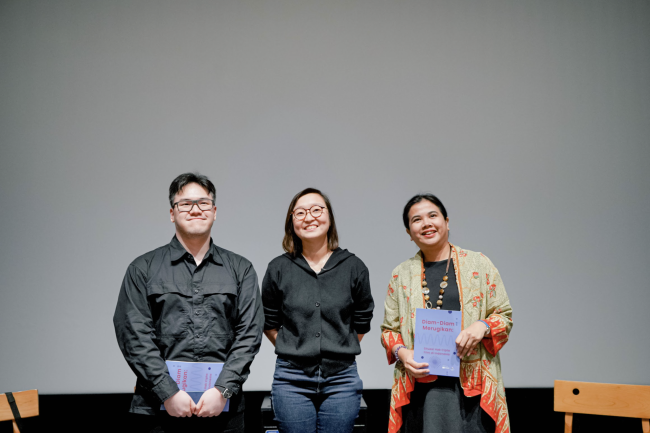
Photo: Koalisi Seni
The film discussion featured Shury Mariasih Gietty Tambunan (Film Copyright Researcher), Edwin Nazir (Film Producer), and Irene Umar (Vice Minister of Creative Economy/Vice Chair of the Creative Economy Agency), moderated by Hafez Gumay (Advocacy Manager, Koalisi Seni). The discussion explored the complexity of the film ecosystem as a collaborative creative practice and the challenges of copyright protection amid the rapid expansion of digital distribution.
Gietty Tambunan highlighted that one of the film sector’s primary challenges lies in the complex relationships among the many actors involved in a highly collaborative creative ecosystem. She explained that “film is a collaborative work… yet the copyright positions of the various parties are often unclear.” This ambiguity directly affects the distribution of economic benefits, as “not every commercially successful film is accompanied by improved welfare for its creators.” She also noted that while examples of good practice have begun to emerge, they remain sporadic and have yet to become industry standards.
From the distribution perspective, the discussion underscored the challenges surrounding relationships between filmmakers and digital streaming platforms. Gietty observed that “information regarding partnership schemes with OTT platforms remains very limited,” making transparency in the management of economic rights an ongoing concern. This lack of transparency may weaken filmmakers’ bargaining position, particularly when negotiating licensing agreements and revenue-sharing arrangements in the digital marketplace.
Meanwhile, Irene Umar emphasized that copyright protection should not be viewed solely through an economic lens. She stated, “we cannot look only at the economic aspect… every subsector deserves protection,” stressing the importance of ensuring equal protection across all branches of the creative economy. She also highlighted the need for a more comprehensive system—ranging from regulation to technical implementation—to ensure copyright protection remains effective amid the rapid pace of technological change.
The discussion further addressed the widespread impact of piracy and illegal distribution in digital spaces. The high level of consumption of unauthorized content demonstrates that the challenge extends beyond technology alone to issues of accessibility, affordability, and public awareness. The unauthorized use of film clips on social media also illustrates the limited public understanding of both moral rights and economic rights.
More broadly, the speakers agreed that the film sector’s greatest challenge lies not only in regulatory frameworks but also in their fragmented and inconsistent implementation. Addressing these issues will require collective efforts to establish clearer contractual standards, improve transparency in industry data, and strengthen copyright literacy throughout the film value chain. These measures are essential to ensuring that the continued acceleration of digitalization goes hand in hand with fair and effective protection for everyone involved in the film industry.
Towards More Equitable and Inclusive Policies
Preliminary findings from the research series show that copyright challenges cut across artistic disciplines and have become increasingly complex in the digital era. From piracy and unequal contractual arrangements to the unauthorized use of creative works, these issues continue to threaten the sustainability of artistic practice and the livelihoods of creators.
Through the research series A Quiet Damage: The State of Copyright in Indonesia’s Arts Sector, Koalisi Seni seeks to provide evidence-based data and analysis to strengthen policy advocacy while promoting a copyright protection system that is better equipped to respond to technological change.
Koalisi Seni also underscores the importance of collaboration among government institutions, industry stakeholders, and the public to ensure that digital transformation does not come at the expense of artists’ rights.
The research reports on the visual arts and theatre sectors will be launched later this month and will be available through Koalisi Seni’s official communication channels.
Written by: Margaret Megan